The right carton gripper depends on what the carton can tolerate and how it must move. Start with the filled carton, its accessible surfaces and the intended pallet pattern. Vacuum contact, side clamping and bottom support each place different demands on the package and the surrounding space. Comparing those conditions is more useful than choosing a tool from its appearance.
Start with the filled carton
Record the minimum and maximum dimensions, filled weight, board condition, closure method and any surfaces that must stay untouched. Ask whether the contents support the top panel or leave a large unsupported area. Include labels, straps, openings and taped seams in the contact review.
Use representative samples rather than one empty display box. Cartons that look similar can respond differently when filled, stored or presented with a different face upwards. Document the acceptable level of marking or deformation before the handling trial.
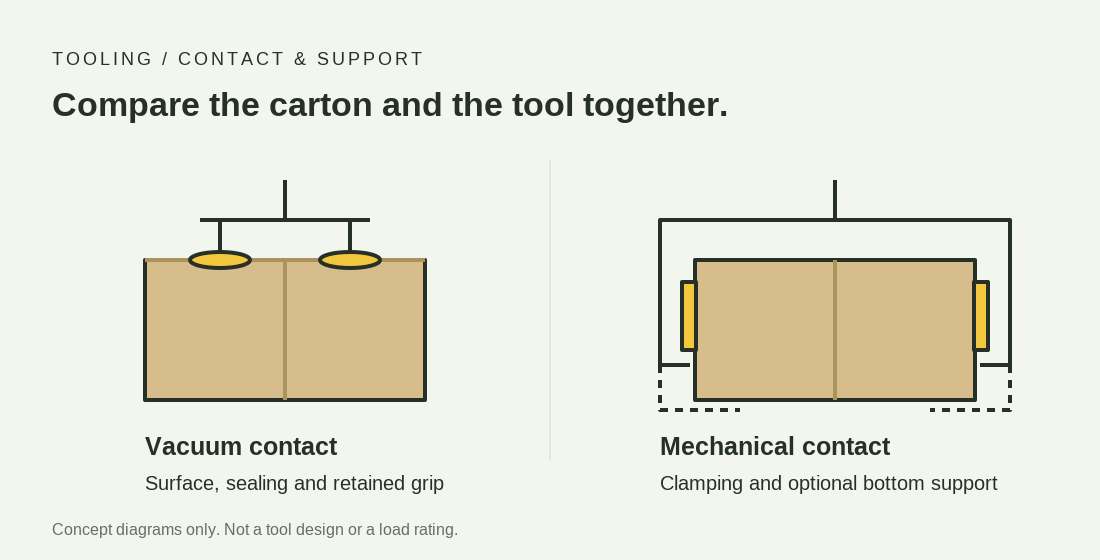
Compare contact and support
| Check | Vacuum contact | Mechanical contact |
|---|---|---|
| Contact surface | Available area, leakage paths, seams and surface variation | Accessible faces, clamp contact and package compression |
| Product support | How the carton carries its contents during lifting | Whether side grip is sufficient or bottom support is needed |
| Space to release | Tool clearance above the carton and pallet | Space for jaws and any supporting fingers to withdraw |
| Complete load | Tool, adapter, vacuum equipment and cartons | Tool, moving mechanisms, adapter and cartons |
| Trials | Pickup, retained grip and controlled release | Contact force, support, retained grip and release |
Neither approach has a universal carton-weight boundary. The selected tool, carton construction, contact conditions and motion need to be assessed together. A combined tool may be appropriate, but each added function also needs space, mass and a defined operating sequence.
Review the complete movement
A successful lift from the conveyor is only part of the task. Check what happens during acceleration, changes of direction and placement at the highest or most restricted pallet position. The carton and tool need clearance along the route, including the approach and withdrawal movements.
For side clamping or bottom support, examine the spaces available between cartons in the intended pattern. For vacuum handling, assess how contact is established and released at the actual pick and place positions. Record the confirmation signals and the response when grip cannot be established.
Include multiple-carton picks in the comparison
Picking two or more cartons changes the handled load, contact arrangement and grouping requirements. Describe how the conveyor forms and counts the group, how each carton is supported and what confirms that the complete pick is ready.
A reduction in robot trips does not by itself establish a higher sustained line output. Group formation, grip confirmation, placement and tool release still take time. Review the complete sequence and check the selected robot load limits, centre of gravity and permitted moments or inertia.
Trial the variations that matter
Agree on a sample set covering the formats and carton conditions expected in production. Include the variants most likely to challenge contact or support, then observe pickup, transfer, placement and release. Record package damage as well as successful movement.
Keep the trial conditions with the result: carton format, contents, closure, tool settings and movement. A result from one carton format should not silently become a claim for the entire product range.
Prepare a useful gripper enquiry
- Carton dimensions, filled weights, photographs and closure details.
- Representative samples and handling or appearance restrictions.
- Number of cartons per pick, incoming orientation and target output.
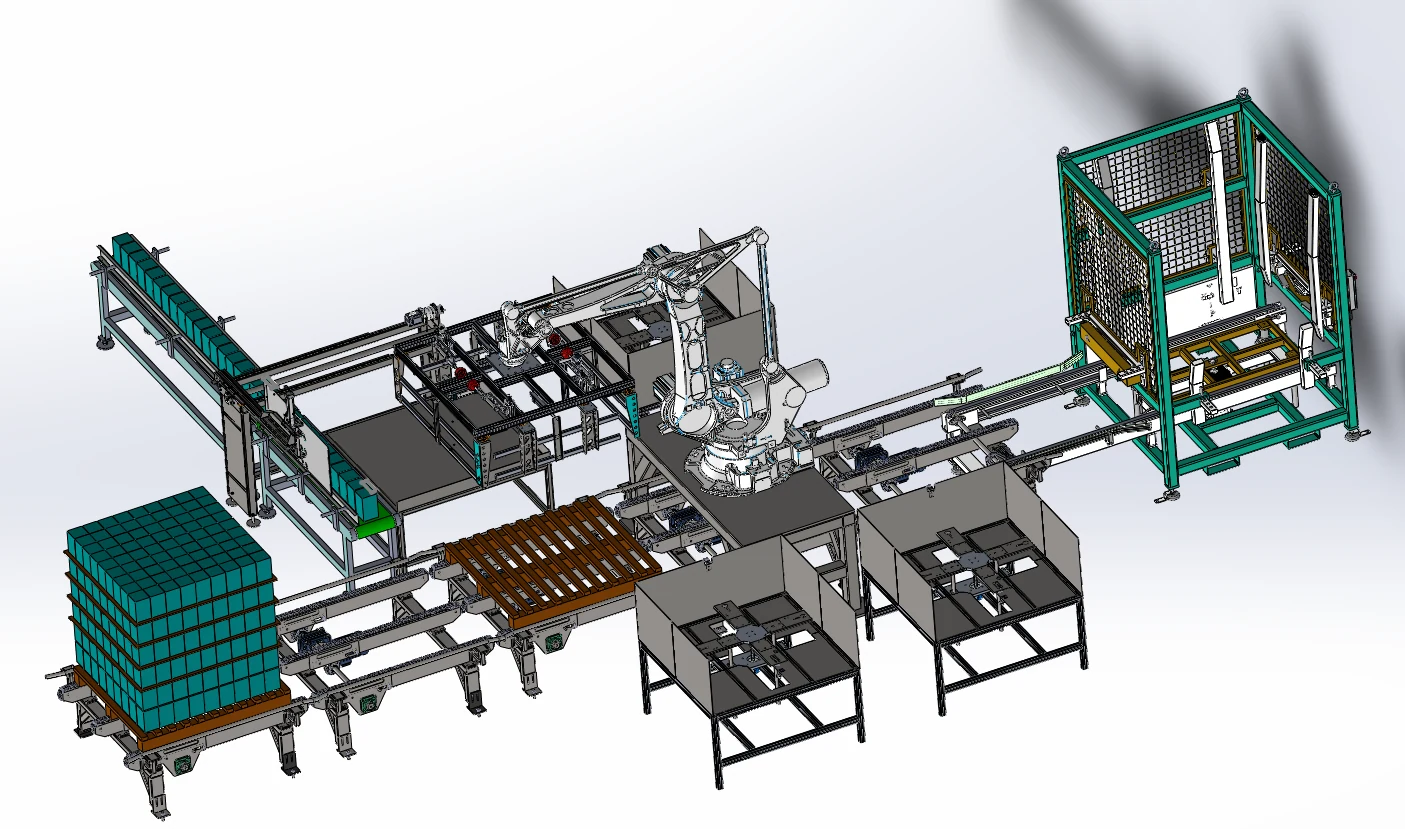
- Pallet pattern, stack height and installation layout.
Send these details with any existing conveyor information. The next step is to compare the gripping concept, robot load and operating sequence as one application.
Application guidance. Final equipment selection and performance conditions are defined for the individual project.