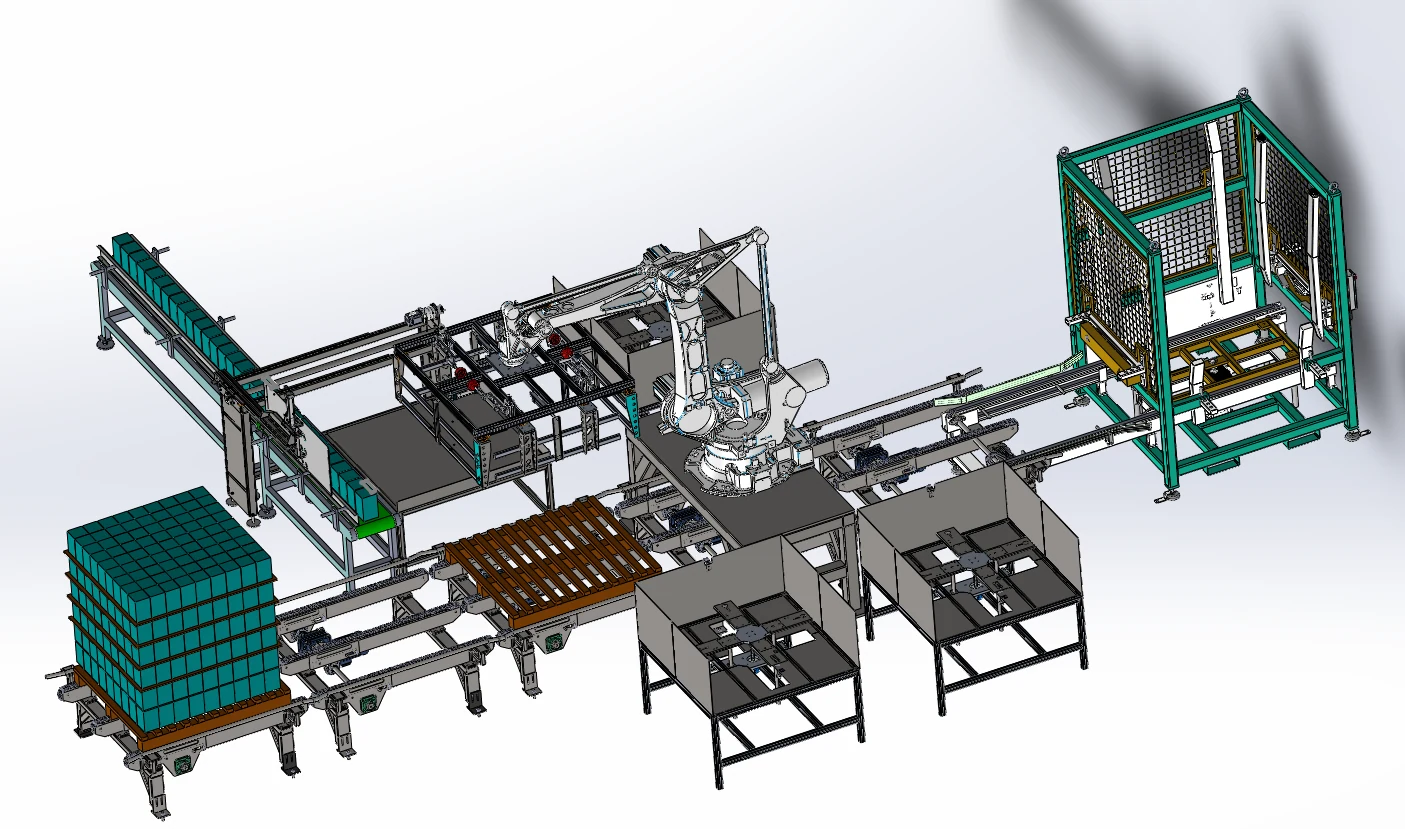
A palletizing cell may need to move products, collect an empty pallet and place layer or top sheets. Combining those functions in one end-of-arm tool can simplify some equipment arrangements. It also gives the robot additional tasks and changes the tool carried during every product movement. Compare the full cycle before deciding which functions should share a mechanism.
List the jobs before drawing the tool
Write the pallet-building sequence from the arrival of the empty pallet to the release of the completed load. Identify every product pickup, sheet placement and pallet-handling action, including the locations where each item is presented.
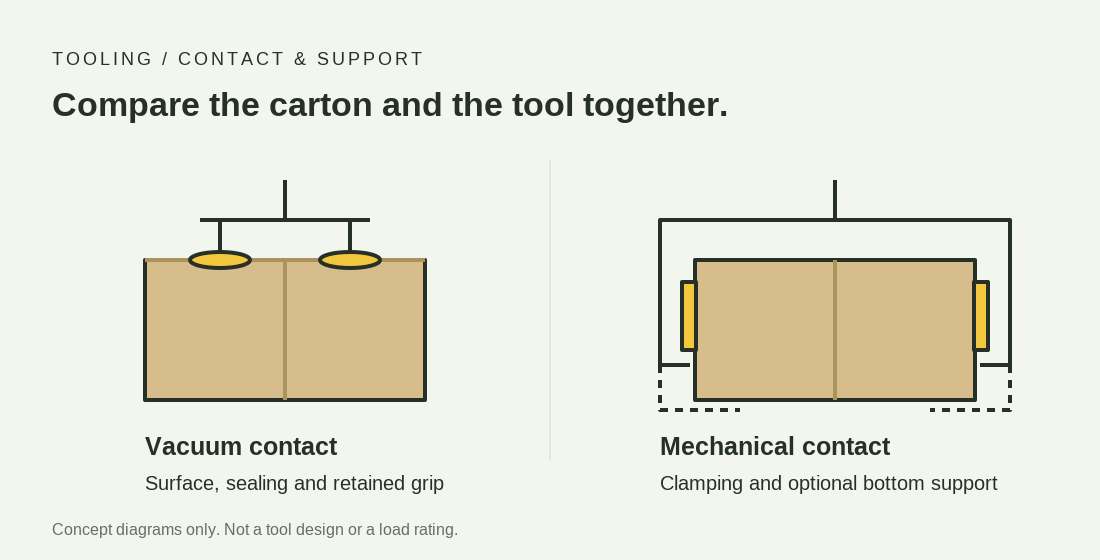
An example composite gripper can combine several handling functions, but a list of functions is not a verified design. Each needs a contact method, available space, a load case and confirmation of successful pickup and release.
Compare responsibilities and trade-offs
| Check | One composite tool | Separate devices |
|---|---|---|
| Robot tasks | Robot performs the agreed product and auxiliary actions | Some auxiliary tasks move to dedicated mechanisms |
| Carried equipment | Combined tool mass stays with the robot | Product tool may carry fewer functions |
| Timing | Auxiliary actions use robot time | Some actions may overlap if the sequence permits |
| Layout | Robot needs access to each supply position | Additional equipment needs its own footprint and access |
| Maintenance | Functions share one assembly | Functions have separate maintenance and control interfaces |
These are review questions, not a rule that one arrangement is faster or cheaper. The answer depends on the required rate, material variation and how the equipment fits into the available space.
Check the load cases individually
Collect the tool mass and centre-of-gravity information, then review product handling, empty-pallet handling and sheet handling as distinct cases. Product mass alone does not describe what the robot carries. Use the selected robot data to check permitted loads and movement conditions.
Also examine physical clearance. Pallet collection may need a different approach from product placement, while sheet pickup may need access to a magazine. The tool should not obstruct the highest layer, adjacent stacks or the required replenishment routes.
Put auxiliary actions into the timing model
For an illustrative pallet with ten layers and a sheet between each pair of layers, there are nine interlayer-sheet placements. A bottom sheet or top sheet adds separate actions if required. This is a counting example, not a production-rate estimate.
Include travel to the sheet supply, pickup confirmation, placement and the return to product handling. Then include empty-pallet supply and finished-load transfer. Compare total demand with the proposed equipment sequence rather than judging only the product-pick movement.
Plan replenishment and recovery
Pallet and sheet supplies need defined material conditions. Record dimensions and permitted variation, magazine arrangement, low-material detection and how replenishment is performed within the reviewed cell layout.
Describe the response to a missed or uncertain pickup. The system needs to distinguish the requested action from the confirmed state. A failed sheet pickup, an unavailable pallet and a product already held by the robot create different recovery situations and should not share an unexplained generic restart.
Ask for a sequence-based proposal
- Product and packaging range, pallet conditions and layer patterns.
- Sheet material, dimensions and placement requirements.
- Required output with its counting units and included actions.
- Layout, supply positions, replenishment and finished-load interface.
A useful comparison shows which device performs each task and which actions can overlap. That makes differences in tooling, controls and integration scope visible before selecting the arrangement.
Application guidance. Final equipment selection and performance conditions are defined for the individual project.